The Private Practice
Nobody is going to make you good at this but you.
Most executives use AI to write emails and summarize documents. A smaller group thinks in it: they see a problem, a deliverable, or a decision and spot where AI fits before anyone else in the room does. The distance between the two is widening every quarter, and nobody on your payroll is going to close it for you.
This is private, one-on-one work with me on your actual calendar, your actual inbox, your actual decisions. You have my number in between.
-
Retained
2 live working sessions a month, and my number for whatever comes up between them. Answered the same business day.
-
You drive, I guide
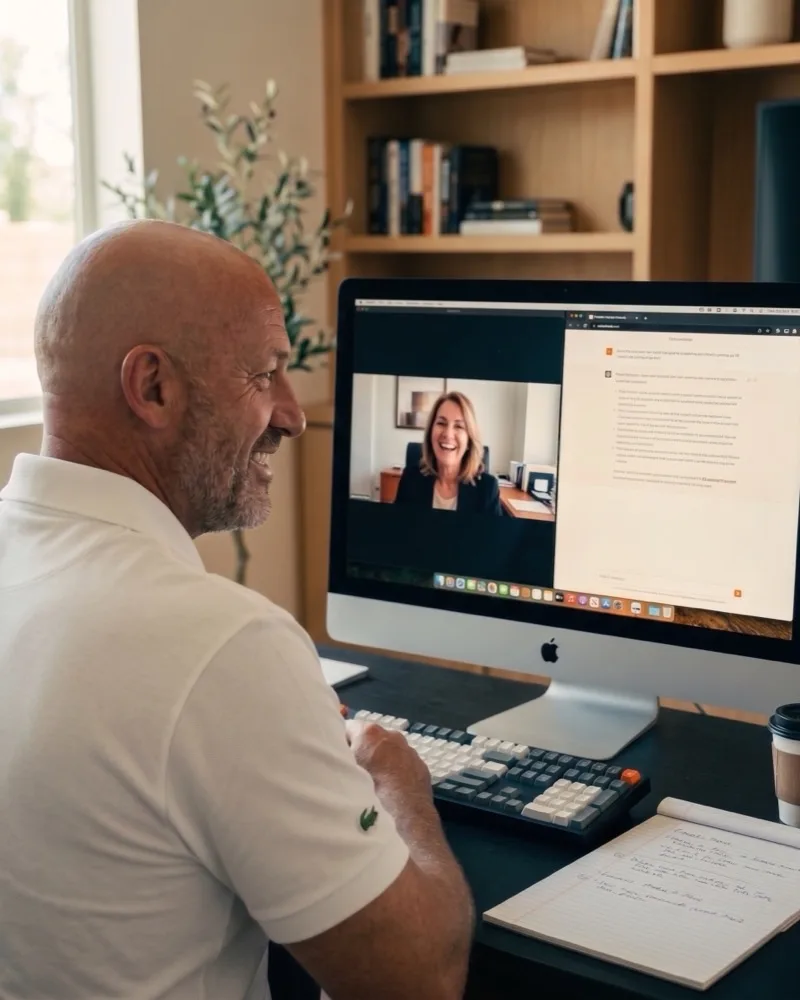
Your mouse, your keyboard, your real work on screen share. The point is muscle memory, and you build it by doing the reps yourself.
-
You keep everything
Every asset, prompt, and configuration is yours, including when you change companies.
10 seats. Session 1 is paid. If it wasn’t worth your time, full refund. No harm, no foul.
25+ years leading teams · About 1,000 CEOs and presidents taught, out of nearly 20,000 business professionals · 4.88/5 Vistage member average · Top 2.5% podcast, Using AI at Work
See the scoresWho this is for
You might think this isn’t for you.
Maybe you’re not buried right now. You’ve got a slower week, some breathing room, a long lunch here and there. That’s the right time for this. The executives drowning in urgent work never get to the important work. The ones with room to breathe are the ones who plant the tree before they need the shade.
It works from either side. If you’re underwater, this hands you hours back. If you have capacity, this is where you spend it before someone else spends theirs catching up to you.
One person at a time. You run a company or a P&L. Your team, your policy, and your rollout are a different engagement, and I’ll point you to it.
Right fit
- You run a company or a P&L and make decisions that cost real money when they’re wrong
- You use AI most days and suspect you’re getting 5% of what it offers
- You’ve been pitched AI projects and can’t tell the good ones from the expensive ones
- You want to be personally capable, and you’re willing to do the reps yourself
Wrong fit
- You want it done for you. You’ll be the one on the keyboard.
- You need your team trained, a company policy adopted, or a system rolled out. That’s a referral to my firm.
- You can’t make 2 sessions a month. The product is the reps.
- You’re looking for tool tutorials. YouTube has 400 free hours of those.
In practice
How I run my own week.
I stopped chasing every new model and tool about a year ago. What’s left is the part that works, and I use it every day in my own business. Some of it:
-
The morning after a sick kid
I’d been up all night and had a meeting I hadn’t prepared for. I told my AI to pull the calendar entry, read the email threads tied to it, and give me a brief with talking points. It did, and it drafted the follow-up emails I’d owe afterward, in my voice. I read the brief on my phone, sent 3 of them, and walked in looking like I’d slept 8 hours. Nobody knew.
-
One agent I manage, and a few I don’t
I run a handful of AI agents. Each one has a role, a scope, and a spot on an org chart, the same as my people. I manage exactly one of them directly: my chief of staff. It routes work to the right agent, checks the output, and hands it back to me. I can go straight to any of the others when something needs calibrating. I rarely have to.
-
A panel that argues with my marketing
A bot pulled 90 days of my site’s visitor data, worked out which market segments were showing up, and built a panel of representative buyers. Standing order: every piece of marketing goes through that panel before it ships.
-
Thirty seconds, in motion
None of this takes a dedicated hour. It takes 30 seconds while I’m walking the dog, driving home, or waiting for a call to tell the AI what I need. It’s handled by the time I check back.
The payoff is fewer open loops on the drive home and the important-but-not-urgent work finally getting done: the business development, the positioning, the story you keep meaning to tell. And when AI comes up in your Vistage or YPO room, you’re the one who actually knows. Nobody dislikes this once they see what’s possible.
Session 1 builds the first piece of this for you, on your accounts, with your hands on the keyboard. By month 3 you’re running your own version.
What gets built
7 things you keep.
Every one passes the same test: you keep it if you change jobs.
-
01
Operating context file
Built in session 1 from the last 30 days of your email and 4 weeks of your calendar. How you decide, who you answer to, what you care about, how you write. Becomes your custom instructions and a portable file that works in any model.
-
02
Connected stack
Your AI wired live to calendar, inbox, drive, and the 1 or 2 tools you personally live in. Working by the end of session 1.
-
03
Personal macro inventory
Every recurring thing you personally do, with honest hours attached and a build-or-skip call on each. This is the diagnostic that sets the next 90 days.
-
04
3 to 5 built assets
Named, working, yours. Drawn from:
- Pre-meeting brief: history, commitments, open items, the questions worth asking
- Inbox and calendar triage that drafts but never sends
- Any report or dashboard reduced to one page, on a schedule
- The recurring document you personally write: board update, investor note, weekly exec summary
- Decision pressure-test: a panel of synthetic advisors who argue with your thinking before you commit
-
05
The scoping rubric
How to tell whether a problem in front of you is an AI project, an automation project, ordinary software, a process fix, or nothing. What it should cost. What done looks like. When to build it yourself and when to hire it out. Tool tricks go stale every time a model updates. This doesn’t, and you can’t get it from a tutorial.
-
06
Personal governance one-pager
What you can and cannot put into these tools, what your actual exposure is, and a starter policy draft you can hand to your team. Draft only. Adoption is a different engagement.
-
07
Leverage log
A running record of hours reclaimed. Conservative, directional, and yours. It is how you justify the next quarter to yourself.
“I could listen to Chris all day! This information was invaluable!”
Vistage member feedback, Charlotte, May 2026
Verbatim, anonymous member evaluations from Vistage sessions. See every score.
The arc
What the first year looks like.
-
Month 1
Wire and diagnose
Session 1 builds the operating context file and connects the stack. Session 2 produces the macro inventory and selects the first 3 builds.
-
Month 2
Build
Both sessions are hands-on builds. You drive, I guide. Assets get named, tested, and put into real use before the next session.
-
Month 3
Judgment
Session 1 applies the scoping rubric to something real on your desk right now. Session 2 covers governance and repairs whatever broke in months 1 and 2.
-
Month 4 and beyond
Standing advisory
The work shifts from building to counsel, on purpose. You text me before you sign with the vendor, approve the tool your team wants, or commit to the workflow that just got expensive. You stay current without spending your weekends on it.
The Private Practice
What it costs.
$3,500/month
10 seats. Application only. Cancel anytime. Your rate is locked for as long as you hold the seat.
- 2 live 60-minute working sessions a month, your hands on the keyboard, your real work on screen
- My number. Text me between sessions with the vendor pitch, the contract, or the thing that broke. Answered the same business day, in writing when you need it in writing.
- Everything built is yours outright: prompts, files, and configurations
- Recordings, transcripts, and an after-action note with the exact prompts used, delivered the same day
- The private group: the other 9 clients plus 1 or 2 of my Chief AI Officers, for real-time gut checks on what’s worth trying
Session 1 is paid. If you get to the end of it and don’t see the value, I refund it in full. No harm, no foul.
Past session 1 there’s no guarantee. Results depend on your reps, and I’m not going to pretend otherwise.
15-minute call, then session 1. No proposal, no deck, no procurement. Or skip the form and text me at (505) 578-5500.
“Best content and put to use presenter I have had in 3 years. Well done on a very loaded topic.”
Vistage member feedback, CEO peer group, Charlotte, May 2026
What the judgment is worth
A commercial construction client had one person spending 20 hours a week on certificates of insurance. Picking that process out of everything else on the list, and knowing it was a 24-hour build rather than a six-month project, is the call the scoping rubric teaches you to make. That build was a company engagement through my firm. What the seat buys is the judgment that picked it.
Run the math
You will approve or kill six figures of AI spend this year. One correct call pays for the seat. If you’d rather count hours: 4 hours a week at a $1,000 loaded hour is about $17,000 a month, against $3,500 for the practice. A full-time AI lead runs $220,000 to $350,000 loaded, takes 6 months to ramp, and might not work out. The leverage log tracks your real number, so by month 2 you’ll know whether the math is holding, in your own accounting.
Confidentiality
What I see, and what happens to it.
The practice runs inside your inbox, your calendar, and your decisions. So the confidentiality terms are short, and they’re in writing before we start.
-
Your accounts, your screen
Sessions run on your screen, in your accounts. Nothing gets installed, and I never hold your logins. What I see in a session stays in the session.
-
Your NDA, signed first
Send yours and I’ll sign it before we book session 1. If you don’t have one, I’ll send a mutual NDA you can mark up.
-
Your data stays yours
The operating context file, the recordings, and every artifact live in your accounts. Nothing you show me is shared with other clients or used anywhere else. When you leave, I keep nothing.
Where this ends
This makes you personally capable with AI. Your company is a separate job.
I keep the line bright on purpose. When you’re ready for the second job, I’ll introduce you to the team that does it.
In scope here
- One executive’s personal capability
- Your personal workflows
- Your personal judgment
Referred to Chief AI Officer
- Team or department training
- Company AI policy adoption or governance rollout
- Anything requiring IT or admin access to company systems
- Anything with a company deliverable, SOW, or procurement process
- Anything a second person at the company also needs to use
Who you’re hiring
One seat buys one person. Me.
I’m Chris Daigle. 25 years operating and scaling companies, the last 3 spent entirely on AI. I founded ChiefAIOfficer.com, wrote The Chief AI Officer Blueprint (2024), sit on the board of the International Association of Chief AI Officers, and host Using AI at Work, top 2.5% of podcasts globally. I’ve taught close to 20,000 non-technical business people how to use this, about 1,000 of them CEOs and presidents. Vistage members score my sessions 4.88 out of 5, with 100% recommending. My next book, Thinking in AI, comes out this year.
The practice came out of a walk in the foothills here in New Mexico, thinking about who actually needs this from me, one person at a time. I run my own business on it every day with a small team, so what you get is what works, brought from a more grounded place than the hype cycle. The version with no room and no audience. Your calendar, your inbox, your decisions.
Questions
Asked before applying.
What does it cost?
$3,500 a month. 10 seats, application only, cancel anytime, and your rate stays where it is for as long as you hold the seat. Session 1 is paid. If you get to the end of it and don’t see the value, I refund it in full. Past that there’s no guarantee, because results depend on your reps.
What do I get each month?
2 live 60-minute working sessions with your hands on the keyboard and your real work on screen. Recordings, transcripts, and an after-action note with the exact prompts, the same day. My number between sessions, answered the same business day. And a private group with the other clients plus 1 or 2 of my Chief AI Officers.
I don’t have time for this.
2 sessions a month. Everything else is 30 seconds on your phone while you’re walking the dog or waiting for a call. Most of what we build runs while you’re driving home. It won’t feel like a second job.
I’m not technical enough.
Good. You don’t need to be. You already understand your business, your customers, and your people, and that’s the hard part. What’s missing is the fluency to tell a real result from an expensive demo when someone pitches you AI work.
Why only 10 seats?
That’s the number where I can still pick up the phone myself. Past that you’d be buying a course with a Slack channel nobody reads.
Why now instead of next quarter?
Nobody can say exactly how every company will be using this a year from now, but the expectations around speed, accuracy, and cost are forming right now. The bar moves whether you’re ready or not. Waiting means you’re behind it once it’s obvious to everyone else.
Won’t this be outdated in 6 months?
The tool tricks will be. Models update and prompt libraries go stale. Thinking in AI carries over to whatever comes next, because it’s a way of approaching a problem, and that’s what we build.
How does confidentiality work?
Sessions run on your screen, in your accounts. Nothing gets installed and I never hold your logins. Your NDA gets signed before session 1; if you don’t have one, I’ll send a mutual NDA you can mark up. When you leave, I keep nothing.
How do I apply?
The application takes about 3 minutes. If it looks like a fit, you’ll hear from me within 2 business days to set up a 15-minute call, then session 1. Or skip the form and text me at (505) 578-5500.
Apply
10 seats.
The application takes about 3 minutes. If it looks like a fit, we’ll do a 15-minute call, then session 1. If session 1 wasn’t worth your time, you get a full refund.
Application received.
I read every one of these personally. If it looks like a fit you’ll hear from me within 2 business days to set up a 15-minute call.
Not ready for a seat?
The Group Room
$500/month · open enrollment
The step-down if a private seat isn’t the right move yet, and where private clients land once their build phase is done.
- One 90-minute live group session per month: teaching plus open Q&A
- Full library of built assets, prompts, and rubrics from the private tier, anonymized
- Peer channel with other operators doing the same work
- First right of refusal on private seats when one opens
The AI use policy
Leave with the policy, even if we never meet.
Every room I speak in leaves with a draft AI use policy. This is that template: what your people can put into AI tools, what stays out of them, and who owns the call. One Vistage member turned it into his company’s policy in 6 minutes.
On its way.
Check your inbox in the next few minutes. If it’s not there, look in spam once, then email me.